
1-805-484-2992
Quotes - Engineering - SalesCAT 3512 Heat Exchanger
Above the single frame selection band
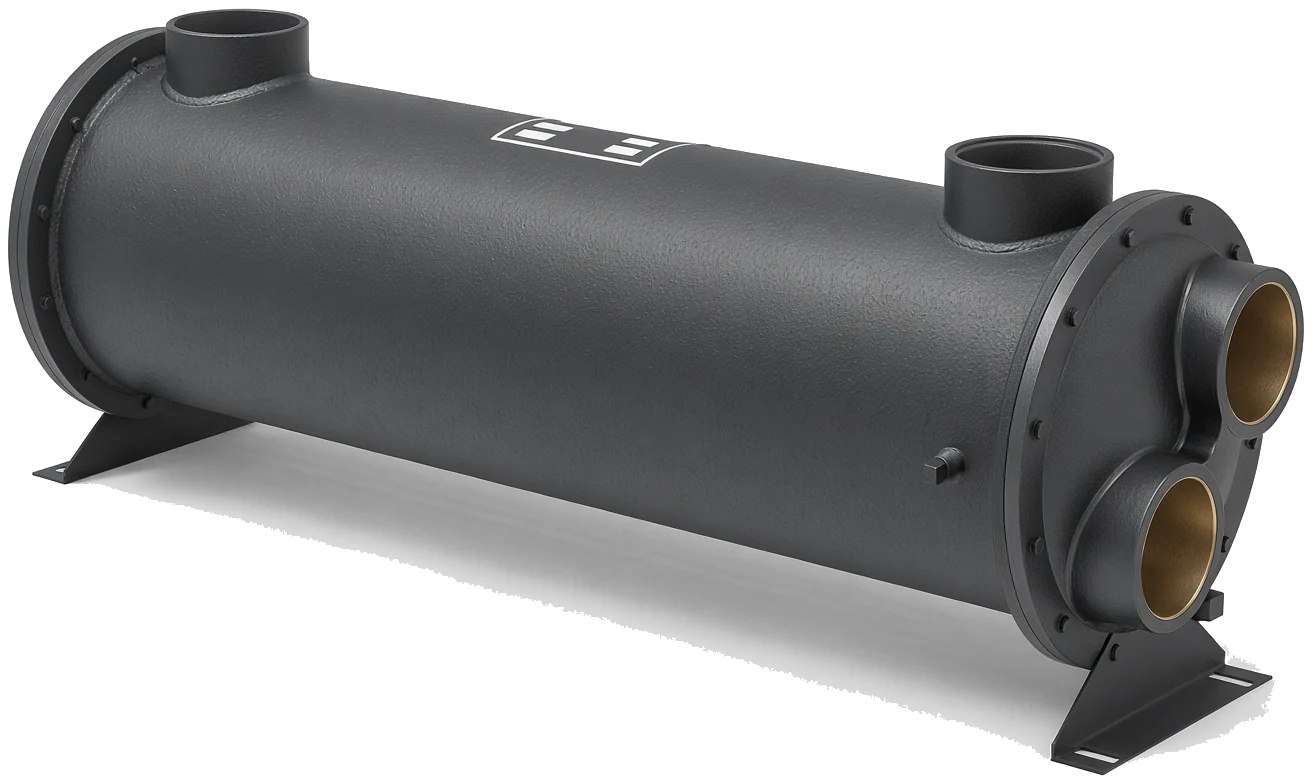
The 3512 is the point where the answer stops being one cooler. Marine ratings are widely published in the region of 1200 to 1800 horsepower, and the published jacket water selection for these shell and tube frames reaches roughly 1250 horsepower on the largest two-pass unit. That means most 3512 installations need either the biggest frame under genuinely favorable seawater conditions, or two units arranged in parallel to share the load.
Neither of those is a catalog selection, so we work it with you. What we need is the rating and duty class, the jacket water heat rejection from the engine data sheet, the design seawater inlet temperature, the raw water flow the pump delivers at the cooler and the head already consumed by strainers and the sea chest. From those the arrangement follows, and we state the clean and fouled performance and pressure drop so the numbers can be checked.
For a CAT 3512 heat exchanger replacement, send the engine serial and rating along with the nameplate or old part numbers, the connection sizes and thread type, and the space and lifting arrangement available. Copper-nickel is standard; titanium tube bundles are common at this size in warm or sediment-heavy water. Call 1-805-484-2992 or email Sales@HeatX.com.
 Parallel Units
 Titanium Bundles
 Stated Drop
 Offshore Duty
Working A 3512 Duty
At this load the calculation is checked against measured flow and head rather than nominal figures.
Duty Inputs
- Rating, duty class and data sheet
- Design seawater inlet temperature
- Measured raw water flow at the cooler
- Head consumed upstream
- Fouling interval you can hold
We Supply
- Single largest frame or parallel pair
- Copper-nickel or titanium bundles
- Bronze bonnets with anode ports
- Flow split and isolation requirements
- Clean and fouled performance figures
Duty Profile
- Seawater tube side, coolant shell side
- Two pass to limit head loss
- Each unit isolatable for cleaning
- Weights and lifting points given
- Anode inventory stated per unit
| MODEL / RATING | HORSEPOWER | DUTY | TYPICAL SELECTION |
| 3512 continuous rating | About 1200 to 1350 HP | Continuous propulsion | Largest HC Series frame, call for rating |
| 3512 intermittent rating | About 1350 to 1600 HP | Intermittent propulsion | Two units in parallel |
| 3512C high output | About 1600 to 1800 HP | High performance propulsion | Parallel arrangement, call for rating |
| 3512 prime power set | About 1200 to 1500 HP | Prime power generation | Parallel or largest frame with ASME |
| Warm or polluted raw water | Any 3512 rating | Seawater duty | Titanium tube bundles |
| Lube oil duty | Sized on oil load | Lube oil cooling | Lube Oil Cooling |
Two Units In Parallel
What the piping has to do
Splitting a 3512 jacket water duty across two coolers only works if the flow splits evenly. Asymmetrical piping, an elbow too close to a tee, or one branch shorter than the other will bias the flow and leave one unit doing more than its share while the other fouls faster in slower water.
So the arrangement is quoted with the piping requirements attached: symmetrical branches, isolation valves each side of each unit, independent vents and drains, and a flow check at commissioning. Done properly it also buys you the ability to clean one unit while the other carries reduced load.
When the coolant outlet has to be low
Occasionally the constraint is not the total heat load but the coolant temperature you have to reach with warm seawater. Two units in series give a better temperature approach than one large unit, because the seawater sees a counterflow arrangement across a longer path and the last stage works against the coldest water.
The cost is pressure drop, which doubles on the raw water side. That is only viable where the pump has head to spare, so it is checked against the flow figures you supply rather than assumed. See Flow and Pressure Drop.
Related


HEAT EXCHANGERS • TITANIUM
Titanium Coolers
Seawater coolers with titanium tubes for hard water
+ Learn More
ENGINEERING • SERVICE
Installation Piping
Branch symmetry, valves and vents on parallel units
+ Learn MoreRating and sizing questions
Often yes at the upper ratings. The published jacket water band for these frames reaches roughly 1250 horsepower on the largest two pass unit, so a 3512 above that generally runs two coolers in parallel. Send your rating, seawater temperature and measured flow and we will confirm which applies.
Symmetrical branch piping, isolation valves each side of each unit, and a flow check at commissioning. Uneven branches bias the split, so one unit overworks while the other fouls in slower water. We supply the piping requirements with the quote so the arrangement performs as calculated.
When the constraint is reaching a low coolant outlet temperature against warm seawater rather than total heat load. Series gives a better temperature approach because the final stage works against the coldest water. The cost is roughly doubled raw water pressure drop, so the pump has to have head to spare.
With a parallel arrangement and proper isolation valves, yes, at reduced load. That is one of the main reasons operators on contract choose two units over one. The reduced capacity has to be acceptable for the operating condition at the time, so plan it into the duty rather than assume it.
The frame or arrangement with full option codes, clean and fouled performance, pressure drop on both sides, connection schedule, dry and operating weights, lifting points and the anode inventory per unit. Where the arrangement is parallel or series, the piping requirements come with it. Call 1-805-484-2992.

