
1-805-484-2992
Quotes - Engineering - SalesCAT C-Series Heat Exchangers
C7, C9, C12, C18 and C32
The C-Series covers an enormous span in one family name. A C7 in a launch and a C32 in a sportfisher have almost nothing in common as a cooling duty, with published marine ratings across the family running from roughly 225 up to about 1900 horsepower. So the first thing we ask on a C-Series inquiry is not the family but the specific model and its rating, because that is what puts us in the right frame range.
The second thing is dimensions. C-Series installations are generally newer and more tightly packaged than the 3400 and 3500 boats, with coolers sitting in space that was designed around exactly one unit. When that unit fails, the replacement has to answer the heat load and still clear the block, the hoses, the wiring looms and whatever the yard fitted alongside it. Envelope is frequently the harder half of the problem.
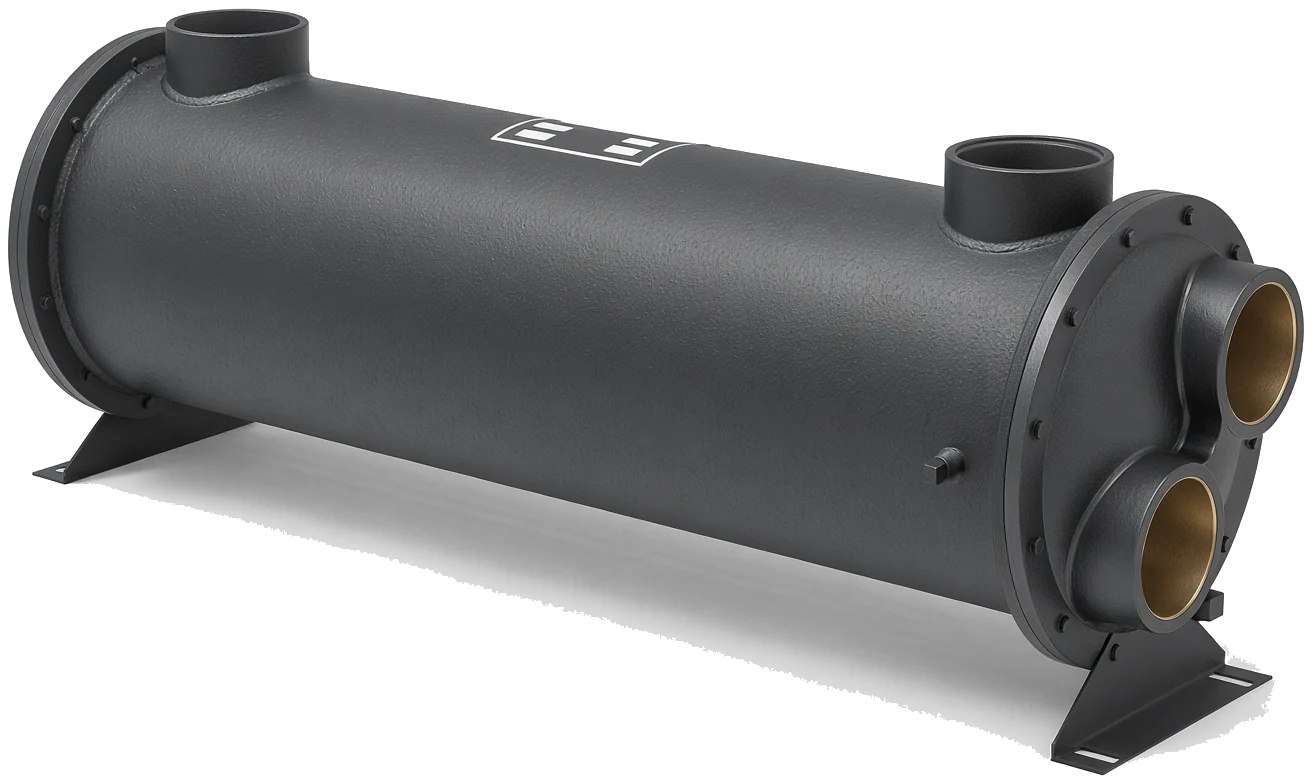
For a CAT C-Series heat exchanger replacement, send the model and rating, the old part number or nameplate, the connection sizes and thread type, the shell diameter and overall length you have room for, and the seawater source. Smaller models often land in the B range; higher-rated C18 and C32 installations move into the larger frames. Call 1-805-484-2992 or email Sales@HeatX.com.
 B Series
 HC Series
 Tight Envelopes
 Charge Air
Fitting Inside A Packaged Installation
On C-Series boats the envelope is measured first and the duty is then met within it.
Duty Inputs
- Specific model and rating
- Heat rejection for the specific model and rating from the data sheet
- Design seawater inlet temperature
- Raw water flow available
- Coolant flow through the shell
Envelope
- Shell diameter that will clear
- Maximum overall length
- Connection sizes, thread and orientation
- Bracket or mounting foot pattern
- Bundle withdrawal clearance
Duty Profile
- Seawater on the tube side
- Coolant on the shell side
- Pass count set by available flow
- Copper-nickel tubes, bronze bonnets
- Titanium option for warm water
| MODEL / RATING | HORSEPOWER | DUTY | TYPICAL SELECTION |
| C7 marine | About 225 to 450 HP | Light propulsion, auxiliary | B Series smaller frames |
| C9 marine | About 375 to 575 HP | Propulsion | B Series or HC Series |
| C12 marine | About 400 to 700 HP | Propulsion | HC Series mid frames |
| C18 marine | About 600 to 1150 HP | High output propulsion | HC Series upper frames |
| C32 marine | About 1000 to 1900 HP | High performance propulsion | Largest HC frames, call for rating |
| Gear and lube oil | Sized on oil load | Oil cooling | Oil Cooling |
One Family, Several Problems
Why the model number is everything
Treating the C-Series as a single line leads to wrong answers. The span from a C7 to a C32 is wider than the entire 3400 family, and the jacket water heat rejection at the top of it is several times what it is at the bottom. There is no C-Series cooler, only a cooler for a C12 at a stated rating, or a C18 at a stated rating.
Give us the model and the rating and the selection narrows immediatly. Where you also know the duty class, wether the engine is rated for continuous, intermittent or high performance service, the heat rejection figure from the data sheet is more precise and the frame choice tighter.
Working inside a space designed for one unit
C-Series boats were generally built with the cooling package designed in rather than added later. That is good engineering and it makes replacement harder, because the space, the hose lengths and often the wiring routing all assume the original dimensions. A cooler two inches longer may be technically correct and physically useless.
We work the other way around on these inquiries. Send the space you have, and we will find the combination of shell diameter, length and pass arrangement that meets the duty inside it. Where it genuinely cannot be done, we will say so rather than ship something that will not go in.
Related


APPLICATIONS • B SERIES
B Series
Compact shell and tube frames from two to eight inch shells
+ Learn More
APPLICATIONS • SEAWATER
Raw Water Cooling
How the whole seawater circuit shares flow and head
+ Learn MoreReplacement questions
It depends on the rating, which across the C18 range spans several hundred horsepower, and on the space you have. Most C18 jacket water duties land in the upper HC frames. Send the rating, the measured envelope and the connection sizes and we will select a frame that meets the duty and fits.
No. Published marine ratings run from roughly 225 horsepower on a C7 to about 1900 on a C32, which is a wider span than the whole 3400 family. There is no single C-Series cooler. Tell us the specific model and rating and the selection narrows straight away.
It is a common symptom. An electronic engine derates quietly as coolant temperature climbs, so a fouled raw water cooler shows up as lost speed or logged derate events long before an alarm. Check the tube bores at the bonnet and compare coolant temperature against the same load as last season.
Usually yes, and on packaged C-Series installations it matters. Give us the connection sizes, thread type and their positions and angle relative to the shell, and we will build to match so the existing hoses reach without rerouting or lengthening anything.
If it draws from the same raw water header, yes. Total flow and head demand across every seawater heat exchanger on the boat is what your pump and sea chest actually see. Adding a pass to one cooler can starve another. Send the circuit and we will check it as a whole.

