
1-805-484-2992
Quotes - Engineering - SalesCAT 3508 Heat Exchanger
Continuous duty and prime power cooling
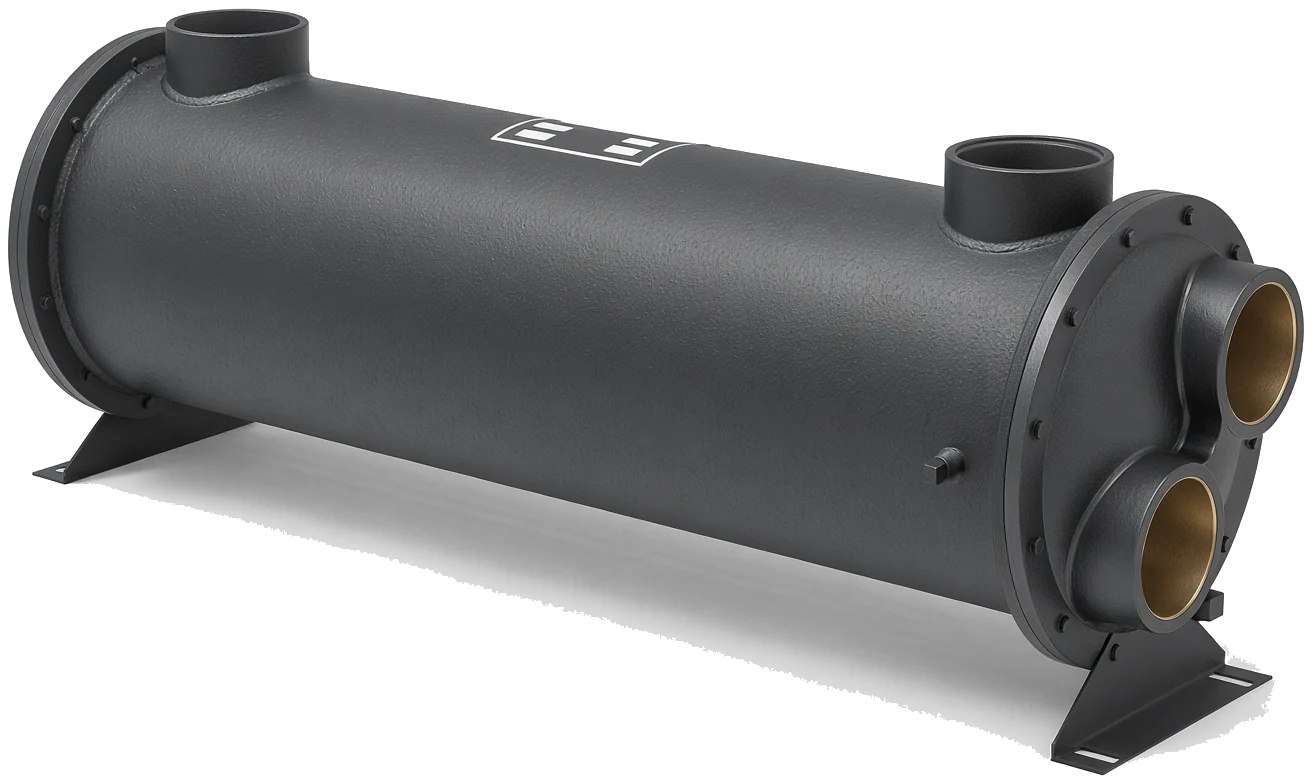
A 3508 is rarely a weekend engine. It turns up in tugs, offshore boats, dredges and prime power sets, running long hours at high load, and the cooling system is asked to hold its duty continuously rather than in bursts. Marine ratings are widely published in the region of 800 to 1200 horsepower depending on duty class, which puts the jacket water load into the upper end of the shell and tube frames built for this service.
The 3508 usually earns its living on continuous duty, in propulsion or as prime power. Ratings run roughly 800 to 1200 HP and the cooler has to hold its duty at the end of the cleaning interval, not just on commissioning day.
Continuous duty changes how a cooler should be specified. The heat rejection figure comes from the engine data sheet for the rating and duty class, as always, but the fouling allowance matters far more on an engine that runs thousands of hours between yard periods. A cooler sized tight to the clean duty will hold temperature for one season and then start costing you load, and on prime power that shows up as a derate you cannot afford.
For a CAT 3508 heat exchanger replacement send the engine serial and rating, the duty class, the nameplate or old part number, the connection sizes and thread type, and your design seawater inlet temperature. Standard build is copper-nickel tubes with bronze bonnets and zinc anodes; ASME construction and 316 stainless shells are available. Call 1-805-484-2992 or email Sales@HeatX.com.
 Continuous Duty
 Large Frames
 ASME Option
 Cleaning Access
Specifying For Long Running Hours
A continuous duty selection carries surface for the fouled condition and states pressure drop across the load range.
Duty Inputs
- Rating and duty class
- Jacket water rejection at the rated output from the data sheet
- Running hours between cleanings
- Design seawater inlet temperature
- Load profile if it varies
We Supply
- Shell and tube cooler with fouling margin
- Copper-nickel or titanium tube bundle
- Bronze bonnets and zinc anodes
- ASME construction where required
- Pressure drop stated both sides
Duty Profile
- Seawater on the tube side
- Jacket coolant on the shell side
- Straight tube bores for rodding
- Removable bonnets for inspection
- Anode ports accessible in place
| MODEL / RATING | HORSEPOWER | DUTY | TYPICAL SELECTION |
| 3508 continuous rating | About 800 to 950 HP | Continuous propulsion | HC Series upper frames |
| 3508 intermittent rating | About 950 to 1200 HP | Intermittent propulsion | Largest HC frames, two pass |
| 3508 prime power set | About 800 to 1100 HP | Generator prime power | AB Series with ASME option |
| 3508 auxiliary standby | About 800 to 1000 HP | Standby power | HC Series mid to upper |
| Lube oil on the same engine | Sized on oil load | Lube oil cooling | Lube Oil Cooling |
Continuous Duty Changes The Sizing
Designing to the fouled condition
A jacket water cooler on a 3508 running prime power may go a year between cleanings. Over that period tube-side scale, silt and growth reduce the effective surface, and the coolant outlet temperature climbs. Sizing to the clean duty means the engine is at its temperature limit long before the next opportunity to open the unit.
We would rather carry the extra surface at the start. Tell us the interval you can realistically hold and the water the vessel works in, and the fouling allowance is set from that. The extra frame length is modest against a derated engine or an unscheduled shutdown mid-contract.
Holding temperature across a load range
Generator sets do not sit at one load. A 3508 prime power set may run anywhere from half load to full, and the jacket water cooler has to hold the coolant outlet inside the engine limits across that range without overcooling at the bottom of it. That usually means selecting for the worst case and controlling on the raw water side.
Send the load profile if it varies significantly. Where the raw water side is shared with other auxiliary heat exchangers, we need the whole circuit. See Generator Set Cooling for how these installations are usually arranged.
Related

ENGINES • CATERPILLAR
CAT 3512
The larger 3500 family engine and its cooling arrangements
+ Learn More

VESSELS & ENGINES • BY VESSEL
Offshore And Government
Long duty cycles where a derate is not an option
+ Learn MoreWhat owners of this engine ask
Enough to hold the coolant outlet temperature at the end of your cleaning interval rather than on commissioning day. The margin depends on water conditions, running hours and how long the vessel lies idle. Give us your realistic interval and we will carry the surface, then state the clean and fouled performance.
Only if the owner specification or the classification requirement calls for code construction on the pressure envelope. It is available on the fixed tube frames used for these duties but must be specified at order rather than added later, so raise it with the inquiry if there is any chance it applies.
Marine ratings are widely published in the region of 800 to 1200 horsepower depending on duty class, with continuous ratings toward the lower end and intermittent ratings higher. The jacket water heat rejection for your engine comes from the data sheet for the specific rating, and that drives the frame selection.
Yes, in one respect. A standby engine spends most of its life not running, so silt settles in the tubes and growth develops in stagnant seawater. That argues for guarding against settled sediment and, in warm or polluted berths, for titanium tubes rather then a larger copper-nickel bundle.

