
1-805-484-2992
Quotes - Engineering - SalesCAT 3412 Heat Exchanger
High output V12 jacket water duty
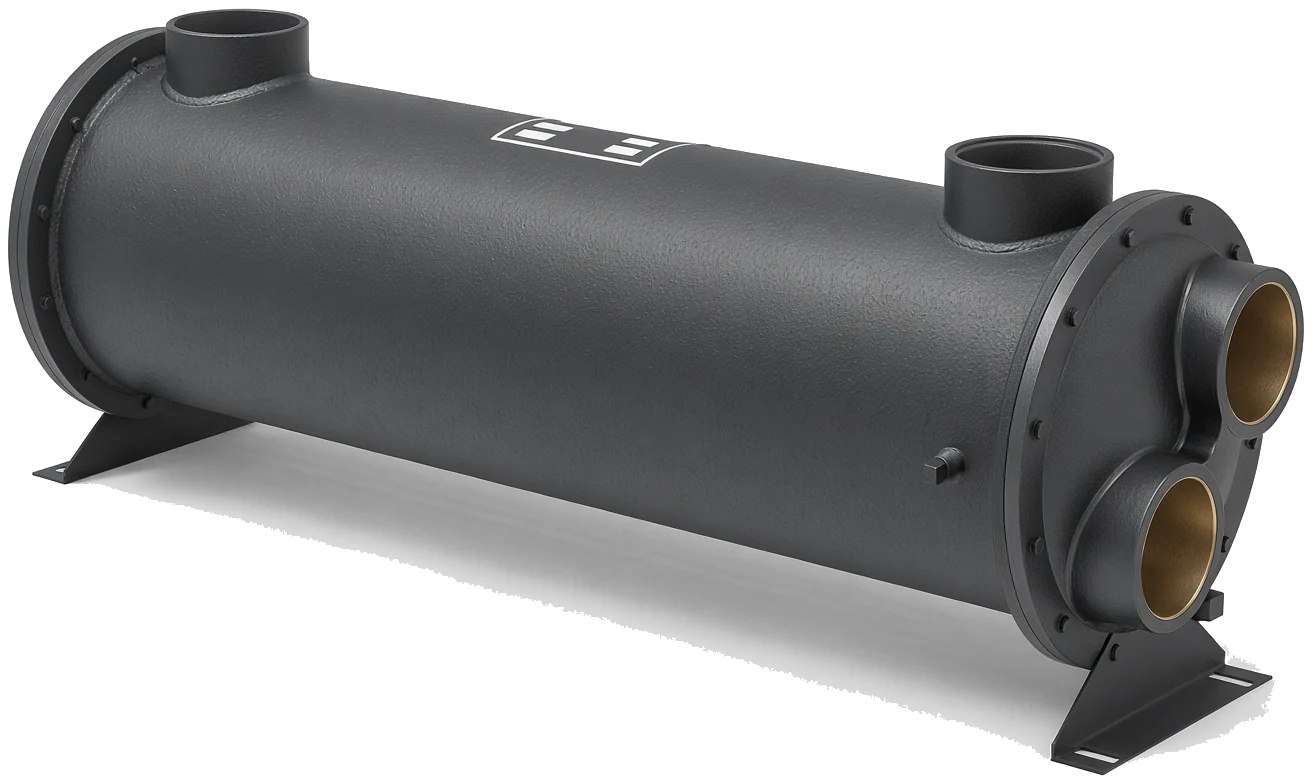
The 3412 is where selection stops being a lookup. Marine ratings are widely published in the region of 600 to 1400 horsepower, and the jacket water load at the top of that band pushes into the largest frames built for this duty. The published jacket water selection reaches roughly 1250 horsepower on the biggest two-pass frame, which means the upper 3412 ratings need favorable seawater conditions, a generous raw water flow, or a different arrangement.
The 3412 sits at the point where a single shell and tube frame starts to run out of room. Ratings run roughly 600 to 1400 HP, and above the middle of that band the seawater temperature and flow you design to decide the answer.
That is a design conversation and we would rather have it before you order than after. The inputs are specific: the rating and duty class, the jacket water heat rejection figure from the engine data sheet, the seawater inlet temperature you design to rather than the one you hope for, and the raw water flow the pump actually delivers at the cooler. Fouling allowance matters too, because a 3412 on continuous duty rarely gets cleaned as often as the schedule says.
For a CAT 3412 heat exchanger replacement, send the engine serial and rating, the nameplate or old part number, the connection sizes and thread type, and the measured envelope. Copper-nickel tubes with bronze bonnets and zincs is the standard build; titanium is common at this size where water is warm or sediment-heavy. Call 1-805-484-2992 or email Sales@HeatX.com.
 Large Frames
 Titanium Tubes
 Flow And Drop
 Fouling Allowance
Sizing At The Top Of The Band
At 3412 loads the selection is worked against your actual seawater conditions rather than a nominal case.
Duty Inputs
- Rating and duty class
- Heat rejection figure for that duty class from the data sheet
- Design seawater inlet temperature
- Measured raw water flow at the cooler
- Fouling allowance you want carried
We Supply
- Large frame shell and tube cooler
- Copper-nickel or titanium bundle
- Bronze bonnets with anode ports
- Connection schedule and weights
- Rating confirmation in writing
Duty Profile
- Seawater tube side, coolant shell side
- Two pass where flow allows
- Pressure drop stated both sides
- Zinc anodes in both bonnets
- Titanium option for hot water
| MODEL / RATING | HORSEPOWER | DUTY | TYPICAL SELECTION |
| 3412 continuous | About 600 to 800 HP | Continuous propulsion | HC Series upper frames |
| 3412 intermittent | About 800 to 1000 HP | Intermittent propulsion | HC Series, two pass |
| 3412C and 3412E high output | About 1000 to 1400 HP | High performance | Largest HC frames, call for rating |
| 3412 prime power set | About 600 to 900 HP | Generator prime power | AB Series or HC |
| Warm or sandy raw water | Any 3412 rating | Seawater duty | Titanium tubes |
| Lube oil duty | Sized on oil load | Lube oil cooling | Lube Oil Cooling |
The Limit Of A Single Frame
What happens above the published band
The jacket water selection published for these frames runs from roughly ten horsepower on a small four-pass unit up to about 1250 horsepower on the largest two-pass frame. A 3412 rated near the top of its range therefore sits at or beyond that edge, and whether one unit covers it depends entirely on the seawater temperature and flow you can guarantee.
We will tell you plainly which side of the line your installation falls. Where a single unit will not carry the duty with a sensible fouling allowance, there are arrangements that will, and we would rather specify one of those than ship a cooler that runs out of margin in its second season.
Head available at the cooler
On large jacket water duties the raw water pressure drop usually bites before surface area does. Four passes give the tube velocity needed for good heat transfer and to keep silt moving, but each pass adds head, and a raw water pump that was marginal when new will not deliver design flow through a cooler that asks for more.
So we ask for pump capacity and the head already consumed by the strainer, the sea chest and anything else on the header. With those numbers the arrangement is chosen rather than assumed. See Flow and Pressure Drop for how the budget is set out.
Related


ENGINEERING • SELECTION
Flow And Pressure Drop
Setting the head budget before choosing a pass arrangement
+ Learn More
APPLICATIONS • ENGINE COOLING
Charge Air Cooling
The other seawater duty on a turbocharged V12
+ Learn MoreMatching the old cooler
It depends on your seawater inlet temperature and raw water flow. The published jacket water band for these frames reaches roughly 1250 horsepower on the largest two pass unit, so the upper 3412 ratings sit at the edge. Send the rating, temperature and flow and we will tell you plainly.
Enough that the engine still runs cool at the end of the cleaning interval you will genuinely keep, not the one in the manual. Tell us your realistic interval and the water the vessel works in, and we will carry the surface to match rather than quote a cooler that only meets duty when spotless.
It is set by the heat load and the pass arrangement rather than fixed by the engine. More flow lets us use fewer passes and a shorter shell; less flow forces four passes and more head. Give us the pump capacity and the head already used by the strainer and sea chest.
Frequently, yes. At this size the tube bundle is expensive and the vessel is usually on a schedule where downtime is costly. If the water is warm, sandy, chlorinated or polluted, or your zincs vanish in weeks, titanium removes the tube corrosion failure mode and generally repays the difference.
Yes, both sides. On a large jacket water duty the raw water pressure drop is often the binding constraint, so it is stated rather than left implicit. That lets you check the selection against the head your pump actually has available at the cooler before you commit.
It changes the inlet condition we design to. Where one raw water supply feeds the aftercooler and then the jacket water shell in series, the water arriving at the second unit has already picked up charge air heat, so the jacket water cooler is sized against that warmer inlet rather than sea temperature. A paralell arrangement splits the flow instead and shares the head budget. Sketch the routing with the inquiry so the right case is used.

