
1-805-484-2992
Quotes - Engineering - SalesCAT 3406 Heat Exchanger
Jacket water and lube oil replacement
The 3406 is the engine we get called about most. It has been in marine service long enough that many of the coolers now failing are second or third replacements, and a fair number of them are shop-built units with nothing legible left on the plate. The good news is that the duty is well understood: a jacket water cooler on a 3406 is a shell and tube unit with seawater in the tubes, coolant in the shell, and zincs in the bronze bonnets.
Ratings matter more than the model badge. Marine 3406 ratings are widely published in the region of 350 to 800 horsepower across the B, C and E generations, and continuous, intermittent and high performance duty classes sit at different points inside that spread. The jacket water heat rejection for your engine comes from the engine data sheet for that specific rating and duty class, and that is the number the surface area is built on.
For a replacement, send the engine serial and rating, a photo of the nameplate or the old part number on the existing cooler, the connection sizes and thread type, and whether the raw water is seawater, brackish or fresh. The standard marine build is copper-nickel tubes with bronze bonnets and zinc anodes; titanium tubes are the option where water is warm or dirty. Call 1-805-484-2992.
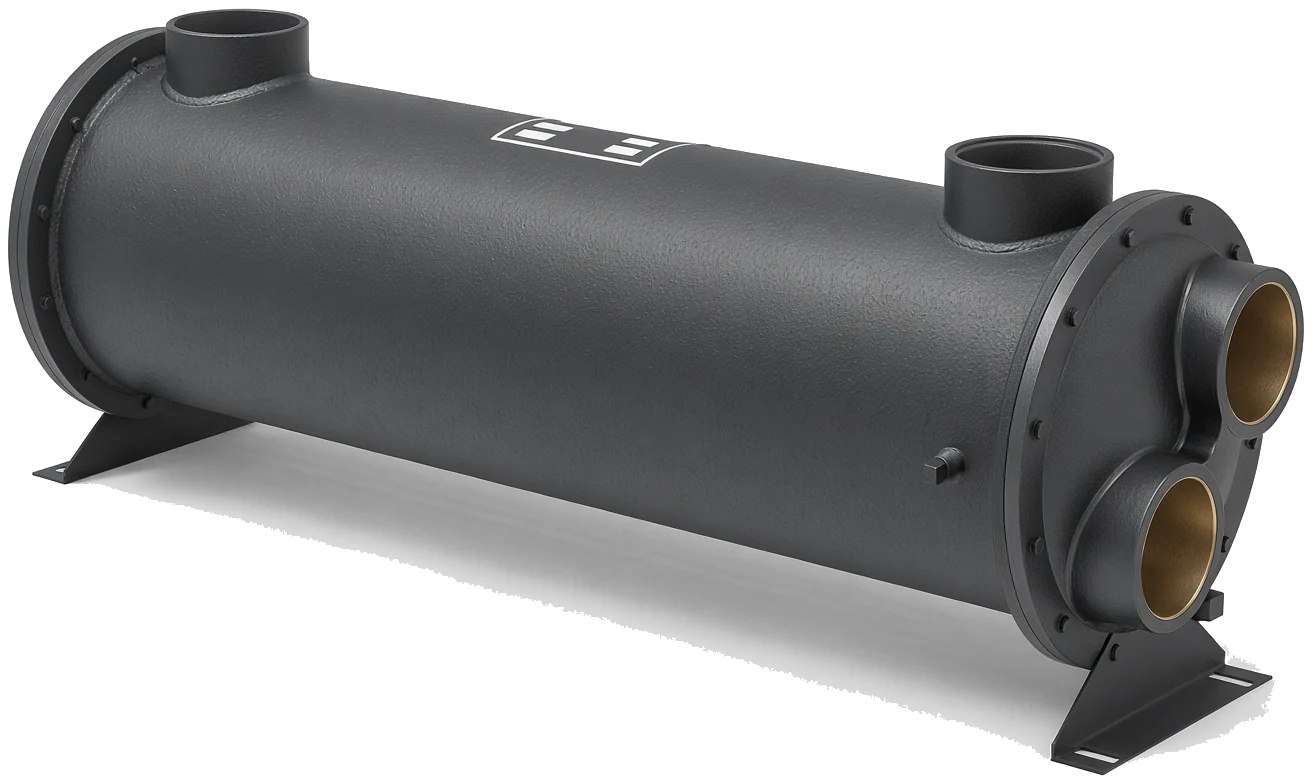
 HC Series
 Lube Oil Cooler
 Zinc Anodes
 Titanium Option
What We Need And What You Get
A 3406 selection is confirmed from four inputs and returned as a full part number with a connection schedule.
Duty Inputs
- Rating in horsepower and duty class
- Jacket water heat rejection from the data sheet
- Design seawater inlet temperature
- Raw water flow available at the cooler
- Allowable pressure drop, both sides
We Supply
- Shell and tube cooler, full part number
- Copper-nickel or titanium tube bundle
- Bronze bonnets with anode ports
- Zinc anodes fitted, spares available
- Connection schedule and dimensions
Duty Profile
- Seawater on the tube side
- Engine coolant on the shell side
- 2 or 4 pass by available flow
- NPT or SAE connections to suit
- Marine option set BR-CN-B-Z
| MODEL / RATING | HORSEPOWER | DUTY | TYPICAL SELECTION |
| 3406B marine | About 350 to 450 HP | Continuous propulsion | HC Series mid frame, 2 or 4 pass |
| 3406C marine | About 400 to 600 HP | Intermittent propulsion | HC Series, longer shell |
| 3406E marine | About 500 to 800 HP | High performance | HC Series upper frames |
| 3406 auxiliary set | About 350 to 500 HP | Generator prime power | AB Series or HC |
| Lube oil duty, any rating | Sized on oil load | Lube oil cooling | Lube Oil Cooling |
Reading The Rating Off The Engine
Why the serial matters more than the badge
A 3406 badge tells you the block. It does not tell you what the engine is rated at, which duty class it was sold into, or what the aftercooling arrangement is, and all three change the jacket water heat rejection. The engine serial and the rating plate settle it, and from there the data sheet gives the heat rejection figure the cooler has to carry.
This is why we do not publish a single cooler part number against the 3406. Quoting one would be wrong for most of the fleet. Send the serial and rating with your inquiry and the selection takes minutes rather than a round of guesswork.
Working from dimensions
Plenty of 3406 coolers in service today were fitted by a yard decades ago and carry no legible identification. That is workable. Measure the shell outside diameter, the overall length across the bonnets, the connection sizes and thread type, the positions of the connections relative to the shell, and the mounting center distances if it sits on feet or a bracket.
Photograph it from two angles including the bonnet face. With those dimensions and your engine rating we can specify a replacement that goes back in to the same space on the same piping. See Replacing an Existing Cooler for a fuller measuring list.
Related


APPLICATIONS • HC SERIES
HC Series
Frame family covering roughly 10 to 1250 HP jacket water
+ Learn More
ENGINEERING • SERVICE
Troubleshooting
Sorting a scaled cooler from a failed tube bundle
+ Learn MoreQuestions on this engine
It depends on the rating. Marine 3406 ratings run broadly from about 350 to 800 horsepower across the generations, and the jacket water heat rejection moves with them. We take that figure from the engine data sheet for your rating and duty class, then size the frame against your seawater temperature and raw water flow.
Often not. The B and E generations sit at different points in the rating spread and can carry meaningfully different jacket water loads, and the installations differ too. Send the serial and rating rather than the generation letter, and photograph what is currently fitted so we can check the envelope.
Yes, that is the normal case. Give us the connection sizes, the thread type, whether they are NPT or SAE, and their positions relative to the shell. We match them so the replacement drops onto the existing piping without reworking hoses or moving brackets.
Scale shows as a gradual climb in jacket water temperature with no coolant loss. A tube failure usually shows as coolant disappearing with no external leak, or oil or coolant traces in the raw water discharge. A shell-side pressure test settles it. See our troubleshooting notes for the sequence.
Yes, where the shell and bonnets are sound a bundle replacement is often the economic repair. We need the frame details or the old part number to match it. If the shell has thinned or the bonnet faces are pitted, replacing the whole unit is usually the better call.

