
1-805-484-2992
Quotes - Engineering - SalesThe Common Deere Replacement
6.8 liter six cylinder ratings
A John Deere 6068 jacket water cooler is the single most requested Deere replacement on this site. Marine ratings on the 6.8 liter six broadly span about 150 to 330 horsepower depending on aspiration and rated speed, and the aftercooled versions sit at the upper end. The heat rejection for your particular rating comes off the engine data sheet, which is why we ask for the model code and rated speed rather than a rounded horsepower figure.
The 6.8 liter 6068 is the most common Deere marine engine we quote coolers for, and no two installations are piped the same. We size on your rating and select a frame that fits your bracket.
The 6068 turns up in trawlers, day boats, pilot launches, small ferries and a great many generator sets, and the cooler installations vary far more than the engines do. Some carry a proper marinizing package with a cataloged exchanger, others a yard fabrication with hose barbs welded where they were convenient. Both are replaceable, but the second kind needs measurements rather than part numbers.
We build the marine option set as standard: copper-nickel tubes carrying seawater on the tube side, engine coolant on the shell side, bronze bonnets and brass tubesheet with replaceable zinc anodes in the raw water end. Titanium tubes are available where the raw water is silty or warm. Send photographs and dimensions to Sales@HeatX.com or call 1-805-484-2992.
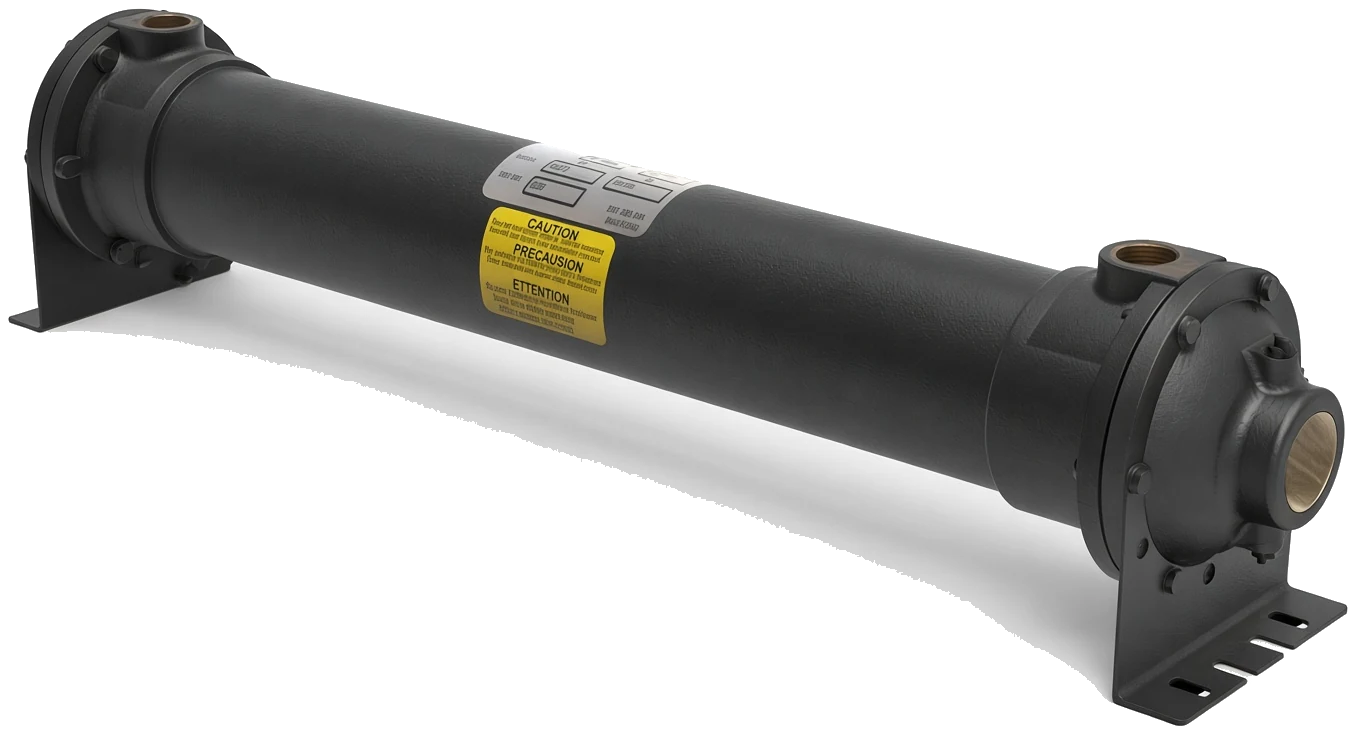
 Jacket Water
 CN Tubes
 Silty Water
 Oil Coolers
What Decides a 6068 Frame
The rating sets the surface, the installation sets the frame and the water sets the material.
Duty Inputs
- Engine model code and rated horsepower
- Rated RPM and aspiration
- Heat rejection from the engine data sheet
- Raw water routing and flow
- Seawater silt load and temperature
What We Supply
- Complete units and replacement bundles
- Copper-nickel or titanium tubes
- Bronze bonnets with zinc anodes
- Lube oil and gear coolers
- Gaskets and mounting hardware
Duty Profile
- Daily commercial running
- Estuary and bar crossings
- Mixed propulsion and hotel load
- Long service intervals expected
| MODEL / RATING | HORSEPOWER | DUTY | TYPICAL SELECTION |
| 6068 naturally aspirated | About 150 to 180 hp | Jacket water | B Series or small HC |
| 6068 turbocharged | About 180 to 250 hp | Jacket water and lube oil | HC Series with CN tubes |
| 6068 turbo aftercooled | About 250 to 330 hp | Jacket water, oil, charge air | HC Series plus lube oil cooler |
| 6068 auxiliary generator | Call for rating | Constant speed jacket water | AB Series or HC Series |
| Silty or warm water service | Any rating | Jacket water, raw water side | Titanium tubes, call for rating |
Diagnosing Before Ordering
Rule the cooler in or out
High jacket water temperature is a system symptom, not a cooler diagnosis. On a 6068 the sequence is strainer, impeller, hose condition, then the tube side. Pull a bonnet and look into the tubes with a torch. Clean bright tube ends with a fouled outer surface tell a different story from tubes packed with scale, and only the second one is the cooler.
A pressure test settles the rest. A bundle that will not hold test pressure on the tube side is passing seawater into the coolant, which is the failure that destroys engines rather than just overheating them. If you find salt in the header tank, stop running the engine and replace the bundle.
Boats that work shallow water
A great many 6068 boats cross bars and work estuaries, which means the raw water carries sand for part of every trip. Sand does two things: it abrades the tube inlet ends at high velocity and it settles in the tubes at low velocity. The pass arrangement is how we keep the flow between those two failure modes.
Strainer discipline does the rest. A strainer that has been bypassing for a season has already put grit through the bundle, and no material choice fully compensates. Where the boat cannot avoid the conditions, titanium tubes are the honest upgrade and they change the replacement interval rather than the maintenance routine.
Related


ENGINEERING • SERVICE
Troubleshooting
Working through overheating symptoms before buying parts
+ Learn More
APPLICATIONS • SEAWATER
Raw Water Side
What silt, sand and warm water do inside the tubes
+ Learn MoreQuestions we get on this model
Broadly 150 to 330 horsepower depending on aspiration and rated speed, with aftercooled versions at the top. Size from the model code on the plate rather than the range, because the jacket water and lube oil heat rejection published for that specific rating is what sets the frame and the pass arrangement.
Stop running the engine. Salt in the header tank means the raw water side has breached into the coolant, and continued running puts chlorides through the block and the head. Pressure test the tube side to confirm, then replace the bundle or the unit. Call 1-805-484-2992 and we will prioritize it.
It is worth pricing. Sand abrades tube inlet ends and warm estuary water accelerates fouling, and a boat on it's second premature copper-nickel bundle is a good candidate. Titanium is an option code on the shell and tube frames we select from, and ratings on titanium builds are set per duty.
No. The bundle has to match the shell, the tubesheet seat and the bonnet arrangement it was built for. What we can do is identify your frame from the shell dimensions and bonnet style and supply the correct bundle for it. Send the measurements and photographs and we will confirm the frame.
Frequently, because constant speed auxiliary ratings sit in a different heat rejection column and the enclosure dictates the envelope. Give us the electrical rating in kilowatts, the engine model code and the space available including penetration positions, and we will select a frame that fits both duty and enclosure.
Measurements, since there is no catalog number to work from. Record the shell diameter, the length across the end fittings, the barb sizes and where each one points, and the mounting arrangement, then photograph the unit from two angles. Add the model code and rated speed from the engine plate and we select a cataloged frame with proper connections that lands in the same space. Expect a short length of new hose rather than any bracket work.

