1-805-484-2992
Quotes - Engineering - SalesCoating Process
What Heresite Does
Heresite is a phenolic coating applied as a liquid and cured by baking, and on an air cooled core it goes onto the fin and tube surfaces as a thin continuous film. Its job is to stand between the aluminum and the salt-laden moisture that would otherwise sit against it. We apply it to the brazed Bar and Plate cores and to Tube and Fin cores before the units ship, so what arrives on the vessel is already a marine core rather than an industrial core with a plan attached.
The reason it matters is the way bare aluminum fails in salt air. Corrosion does not start on the flat faces; it starts at the fin roots, where the fin meets the tube and where salt deposits hold moisture longest. The aluminum wastes there, the fin loses contact with the tube, and the thermal path from oil to air is broken fin by fin. The core still holds pressure throughout, so nothing leaks and no alarm sounds. Performance simply drains away.
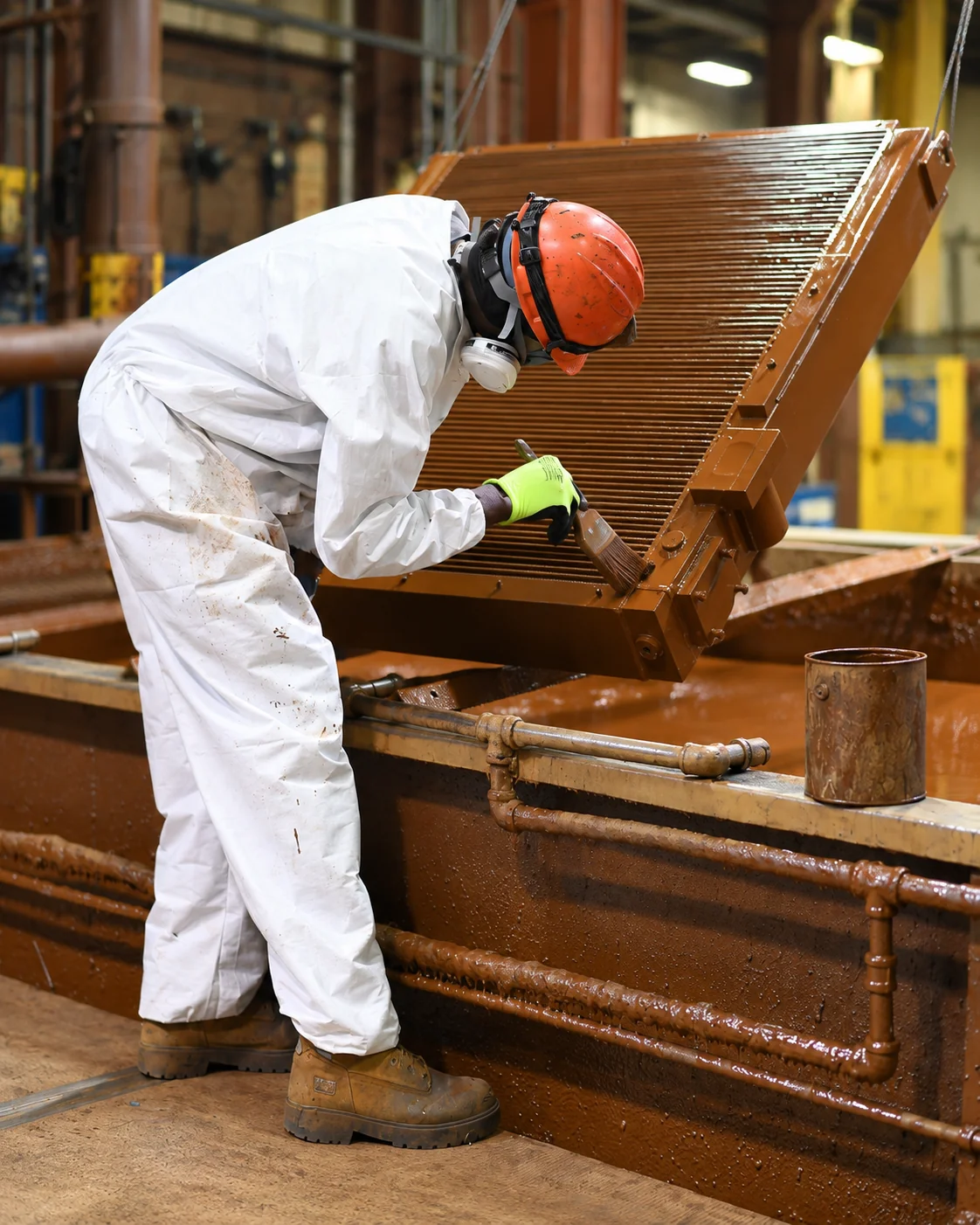
Coating is a factory-controlled process: the core is cleaned, coated and baked under controlled conditions. It is not something to brush on at a mooring, and it cannot be applied usefully to a core that has already begun to corrode at the fin roots.
Request a Quote



Why Fins Fail Before Tubes
A fin is thin metal with a long edge and a tight junction where it meets the tube. Salt spray dries on it, leaving a hygroscopic deposit that pulls moisture out of humid air and holds it against the metal in the tightest part of the geometry. That is a concentration cell, and aluminum in it corrodes far faster than the same alloy on an open flat surface.
Because the tube wall is thicker and the pressure boundary is elsewhere, none of this produces a leak. The oil stays inside and the core keeps its shape. What is lost is the metallic path from tube to fin to air, and with it the majority of the core's heat transfer surface. This is the specific failure a coating is bought to prevent.
Coating and Thermal Performance
Any film on a heat transfer surface adds thermal resistance, and it is fair to ask what that costs. On an air cooled core the dominant resistance is the air-side film, not the metal or a thin coating, so the penalty from a properly applied phenolic layer is small relative to the resistances already in the path.
In practical selection terms it sits inside the margin any sensible design carries for fouling and ambient variation. Set against a core that loses a large fraction of its effective surface in two or three seasons uncoated, the arithmetic is not close. We select on the coated condition, so the figure quoted is the figure you get.
What the Coating Cannot Do
It is a barrier, and a barrier works while it is continuous. A dropped shackle, a boot through the fins, a wire brush used in anger or a high pressure lance held too close all break the film, and bare aluminum at that spot behaves like an uncoated core. Damage tends to be local, so the effect is local, but it is worth avoiding.
It also cannot rescue a core that has already started to waste at the fin roots. Coating needs clean bare metal to adhere to, and coating over corrosion products seals them against the aluminum where they continue to work. A core with detaching fins is replaced, not recoated.
Keeping a Coated Core Working
Rinse with fresh water on the same schedule as the rest of the deck gear, working from the discharge face outward so debris leaves the way it came in. Use a hose rather than a lance; high pressure water flattens fins and cuts the film. Clear the fan guard of line, net and leaves, which on a working boat fills faster than anyone expects.
Inspect the fin roots once a season with a torch. What you are looking for is white powdery product at the joint, which is the beginning of the failure the coating exists to delay. Catching it early lets you change the wash-down interval or the mounting position before the core is scrap.
Silent Failure Prevented
An uncoated core in salt air stops transferring heat long before it stops holding pressure, which is why nobody notices until the oil temperature alarm goes.
Sizing questions
A phenolic coating applied as a liquid and cured by baking, which leaves a thin continuous film on the fin and tube surfaces of an air cooled core. HeatX applies it to AKG cores for marine service before the unit ships. Its purpose is to keep salt-laden moisture off the aluminum, particularly at the fin roots.
No. The core stays rated at 250 PSI and 250 degrees Fahrenheit, and the connections and geometry are unchanged. Coating is a surface treatment, not a construction change. Any thermal effect from the film is small compared with the air-side resistance that dominates an air cooled core, and it sits inside normal selection margin.
Only if it is clean and undamaged. Coating needs bare sound metal to bond to, and it is a controlled cleaning and baking process rather than something applied on board. If the fin roots have already begun to waste, coating traps corrosion products against the aluminum and a replacement core is the honest answer.
Substantially longer than a bare one, with the actual figure depending on exposure, wash-down discipline and physical damage. What changes is the failure mechanism: instead of fins wasting at the roots within a few seasons, the core continues transferring heat and the limiting factors become impact damage and general wear.
Use a hose, not a lance. High pressure water flattens fins, which blocks airflow, and it can cut the coating film and expose bare metal. Rinse with fresh water from the discharge face outward so that salt and debris leave the way they entered, and clear the fan guard at the same time.