
1-805-484-2992
Quotes - Engineering - SalesSacrificial Protection
Anodes in a Heat Exchanger
A zinc anode works by being less noble than everything around it. In a bonnet full of seawater with a brass tubesheet, copper-nickel tubes and a bronze casting, zinc is the most anodic metal present, so the galvanic cell that would otherwise attack the tubesheet and tube ends attacks the zinc instead. The tubesheet face is protected for exactly as long as the zinc lasts and not one day longer.
The cheapest part on the cooler and the one that decides how long everything else lasts. Zinc anodes are consumed by design, they thread into the bonnets where seawater flows, and they only work while there is metal left on them.
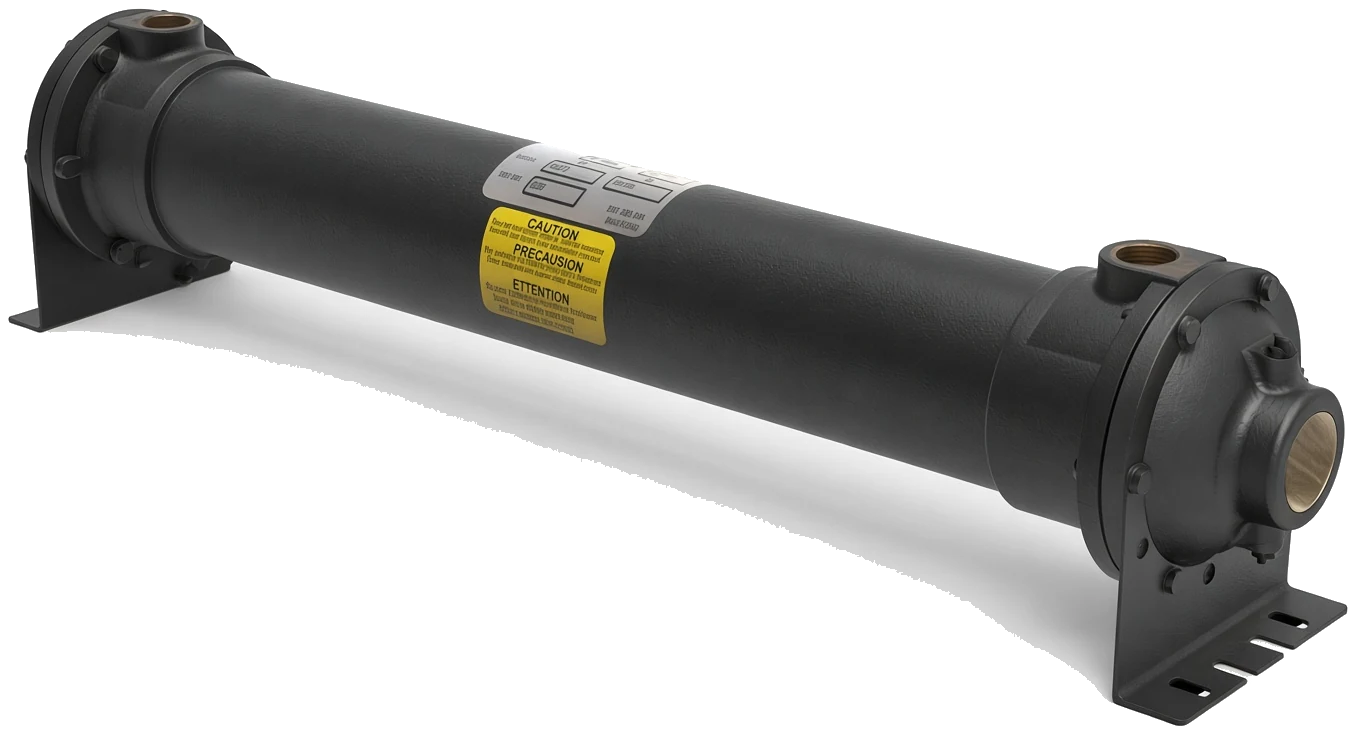
In this range the anodes are pencil type, threaded into bosses in the bonnets so they sit directly in the flowing seawater upstream of the tubesheet. That position matters. An anode tucked into a dead corner protects the metal near it and little else, and an anode that has broken off its plug and is rolling loose in the bonnet is doing nothing at all while still appearing to be fitted.
There is no universal replacement interval. Water chemistry, temperature, flow and stray current on the vessel all change consumption rate, so the first inspection is what sets the schedule for that boat. Inspect at every service and replace at about half consumed.
Request a Quote



Where the Anode Has to Sit
Protection falls away with distance in seawater, so an anode works best when it is close to what it protects and in the stream that carries current between them. The bonnet bosses in these frames put the anode ahead of the tubesheet in the water path, which is where tube-end attack starts. That is a design decision rather than a convenience.
It also means the anode has to be a full anode. Pencil anodes waste from the outside in and eventually the remaining zinc breaks away from the plug thread. From that moment there is a plug in the boss, no electrical connection to the assembly, and nothing protecting the tubesheet, while an inspection from outside shows a properly fitted plug.
Setting the Interval for Your Boat
Consumption rate is a property of the installation, not the anode. Warm water, high velocity, a lot of dissimilar metal in the seawater circuit and any stray current from shore power or bonding faults all raise it. Two identical vessels in different berths can differ by a factor of several in anode life.
So the method is simple: inspect at every service for the first year, record how much zinc has gone, and set the interval so anodes are replaced at around half consumed. If a set is gone entirely at inspection, the interval was too long and the tubesheet has been unprotected for part of the period. Halve it and inspect the tube ends.
When Anodes Disappear Too Fast
An anode consumed in weeks rather than seasons is a symptom, not a maintenance item. The usual causes are stray current from a faulty shore power connection or bonding system, a large area of bare dissimilar metal newly introduced into the seawater circuit, or a titanium bundle fitted in place of copper-nickel without the anode arrangement being revised.
Chasing it with more zinc treats the symptom. Find the electrical fault or the metal that changed. Our Galvanic Corrosion notes cover how the circuit is assessed, and the anode arrangement then follows from what the circuit actually contains.
Doing the Job Properly
Changing anodes means pulling bonnets, and a bonnet that comes off needs a new gasket going back on. Order gaskets with every anode set. Clean the boss thread, use a sealant suited to seawater service and to the boss material, and do not overtighten a brass plug into a bronze casting; the casting is more expensive than the plug.
While the bonnet is off, look at what the anode has been protecting. Tube ends and the tubesheet face are where attack and inlet erosion appear first, and this is the only time anyone sees them. Photograph the face each service and a slow trend becomes visible long before it becomes a leak.
Half Gone Means Replace
An anode consumed past halfway has lost most of its surface area and most of its output, so waiting for it to disappear entirely is not thrift.
Questions we answer every week
There is no universal figure because consumption depends on water temperature, velocity, the metals in the circuit and any stray current. Inspect at every service, record how much zinc has gone, and set the interval so anodes are replaced at around half consumed. Fully consumed at inspection means the interval was too long.
Zinc is what these bonnets are designed around for seawater service, and it is what we supply. Anode alloy choice interacts with water salinity and with the rest of the vessel's protection scheme, so it is not a swap to make casually on one component. Call us before changing alloy on a heat exchanger.
That is a symptom rather than a maintenance issue. Look for stray current from a shore power or bonding fault, a newly introduced area of bare dissimilar metal in the seawater circuit, or a titanium bundle fitted where copper-nickel used to be. Find the cause; adding more zinc only delays the diagnosis.
Yes, and arguably more than before. Titanium is noble, so everything else in the wetted assembly becomes more anodic relative to it than it was with copper-nickel tubes. The titanium needs no protection itself, but the bonnets, tubesheet and surrounding pipework do, and the anode arrangement should be revised accordingly.
Then it has been doing nothing since it broke, even though the plug looks correctly fitted from outside. Remove the plug, retrieve the loose zinc from the bonnet so it cannot block a tube, fit a new anode and a new gasket, and inspect the tubesheet face for the attack that happened while it was unprotected.

